Reading Medicine Information in a Second Language: A Patient Checklist
A translation can sound smooth and still lose the words that make a medicine instruction meaningful. “Before”, “after”, “only” and the unit beside a number can change what a sentence applies to. Keep the original passage beside the translation so the pharmacy or care team can resolve the exact point of uncertainty.
Keep the condition attached to the instruction
Use the leaflet belonging to the actual product and preserve the heading above the unclear sentence. Ask three questions: under what condition does it apply, what action does it describe, and which product or presentation is it about? A smooth translation can still lose one of those links. Keep every number with its unit and any denominator when making a translated note; a bare number is not a faithful copy of the expression.
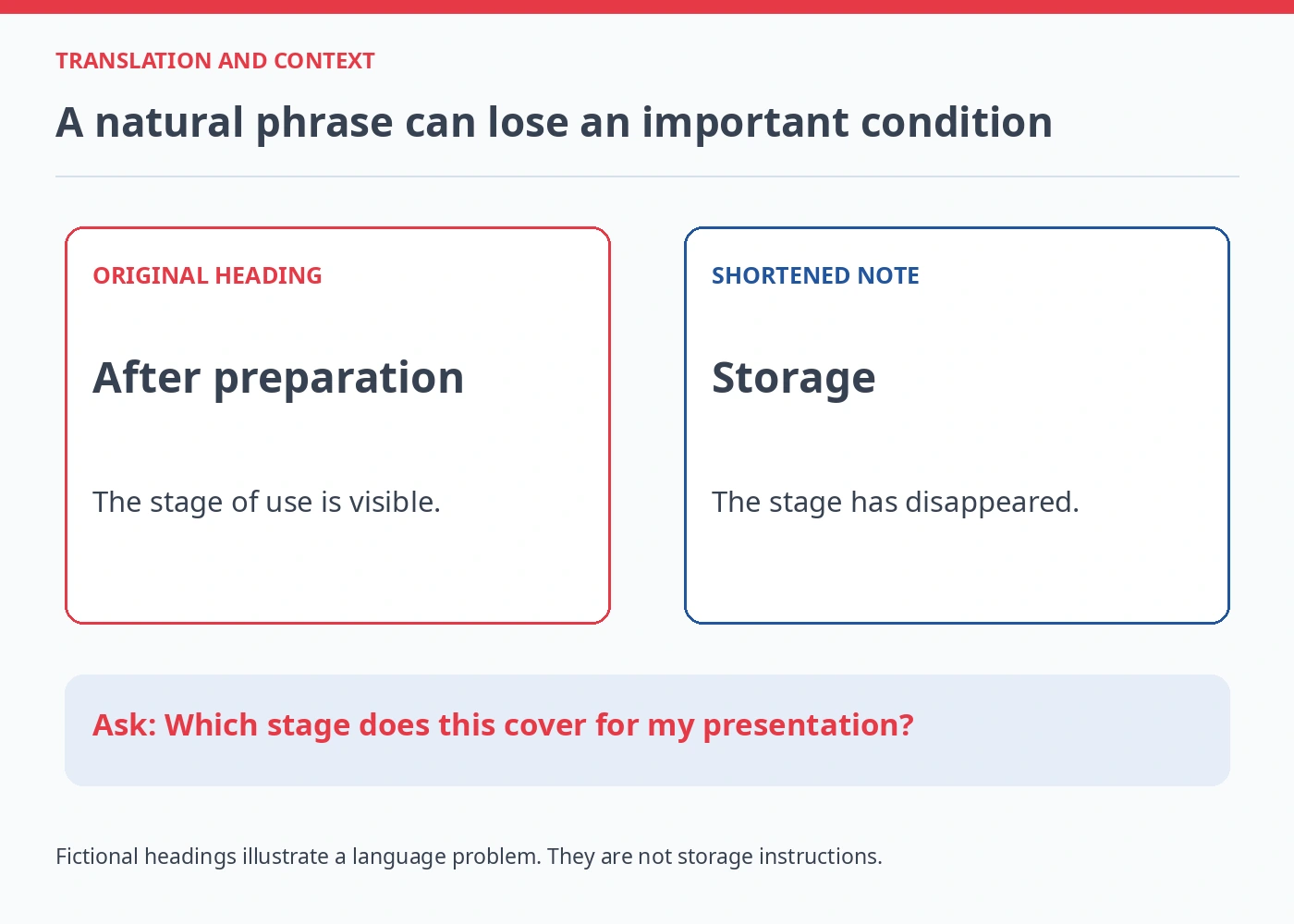
The fictional heading “After preparation” becomes much less precise if a shortened note calls it only “Storage”. The wording is grammatically simple in both cases, but the second version drops the stage of use. Recover the original heading and surrounding paragraph before asking for clarification.
One missing condition changes the reading
The two short headings are fictional language examples, not medicine-storage instructions.
| Part | Illustrative wording | What changes |
|---|---|---|
| Original heading | After preparation | A particular stage is named |
| Shortened heading | Storage | The stage is missing |
| Question to the professional | Which stage does this instruction cover for my presentation? | Bring the full original passage |
| Confirmed explanation | Record the actual answer beside its source | Keep it linked to the same product and document |
Example: a fluent translation with one important gap
A reader has translated the action but left out the heading. Rather than guessing whether the instruction applies at every stage, the reader brings the original passage and asks the pharmacy to explain its scope. The confirmed explanation goes beside the original wording, with the product and document date. A translation taken from another presentation would leave a different problem unresolved.
Check whether an unfamiliar word is a brand, ingredient or presentation before translating it. Growth Hormone Brand Names and Generic Names: Reading the Label
Ask for explanation in ordinary language
Write what you think the sentence means and show it to the pharmacist or treatment team. Ask them to explain the practical instruction and check your understanding. When an interpreter is needed, arrange one through the care service and confirm the language in advance. A friend or app should not silently become the final authority for an unclear medical instruction. [3]
Create a small clarification glossary
Keep a short list of terms that recur in your own documents, together with the explanation confirmed by the professional. Record the product and date next to the entry so a later device change does not inherit an old instruction by accident. The glossary is a memory aid for your consultation, not a new translated patient leaflet.
If the document is for travel, prepare a medicine travel letter with the original product details kept beside any translated version.
A personal glossary supports a conversation; it does not replace the leaflet
Do not use machine translation alone to choose a dose, device setting or treatment change. Obtain clarification from the healthcare team responsible for your prescription.
Sources and reading context
- HealthHub somatropin patient information — Brand-specific device instructions and questions for the healthcare team; not a universal regimen
- AHRQ preparation for healthcare appointments — Organize concerns, questions and medicines for discussion
- UK language interpreting and translation guide — Communication principles only; NHS rights and free-service rules are not Thai entitlements