Keeping a Useful Record of Your Prescribed Growth Hormone Medicine
A medicine record is useful when it lets you reconstruct a supply without relying on memory. Which presentation was received, which leaflet belonged to it, and what advice followed a concern? Keeping those links intact matters more than having a complicated spreadsheet.
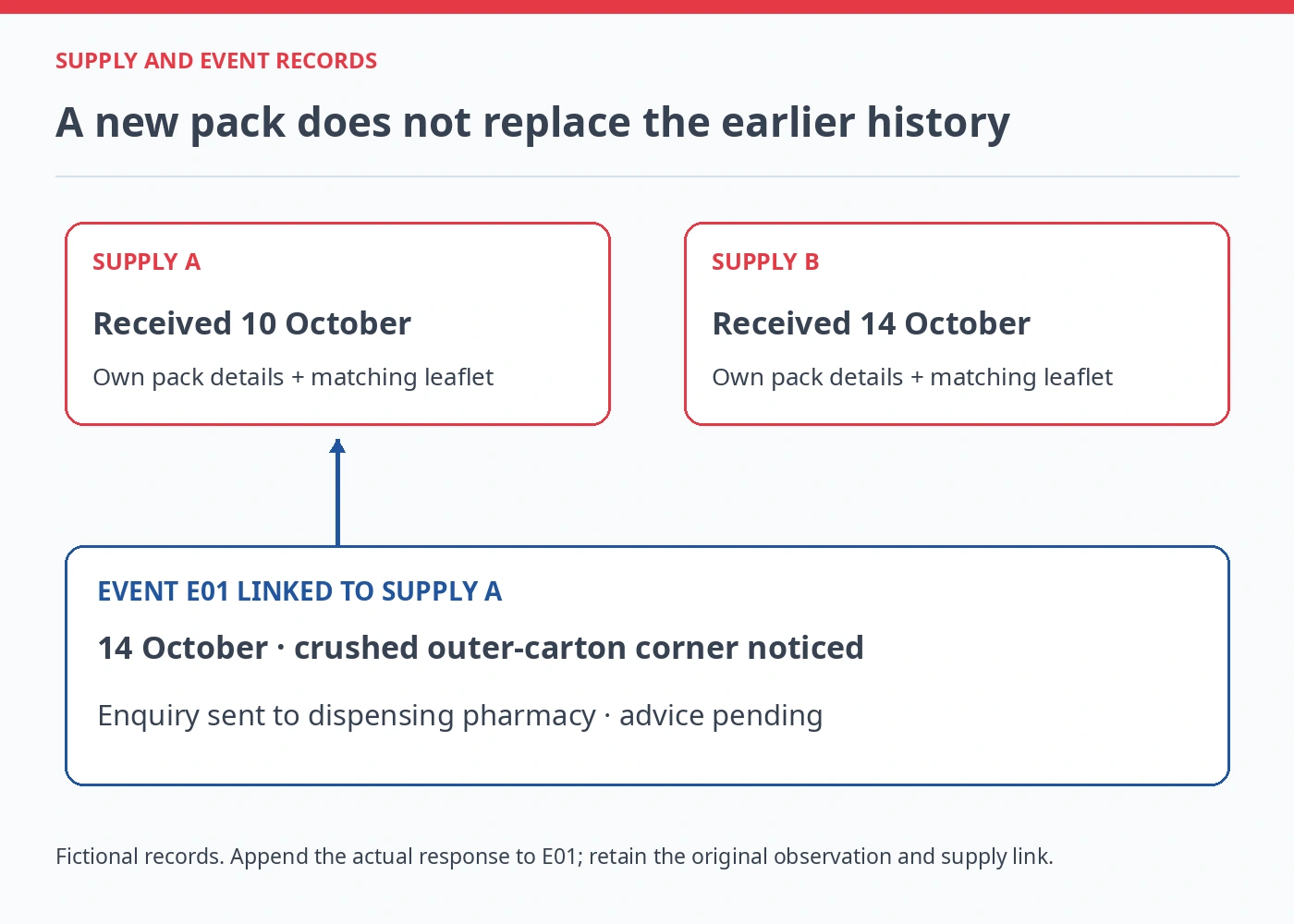
Keep supplies and events as separate records
Give each supply an identifier, then keep its printed details and matching documents together. Record brand, ingredient, strength, presentation, batch, expiry and dispensing date; retain a clear label image. HealthHub directs readers to the specific prescribed brand’s leaflet. A later pack should have its own entry rather than silently replacing the earlier one.
Give each concern a dated event entry that points back to the supply involved. This makes it possible to follow a device question or damage report even after another pack arrives. Keep observation, question and professional response in different fields. [1] [2]
A later event can still belong to the earlier supply
Dates, identifiers and observations below are fictional. Supply A and B each have their own full identity record; this extract shows how the records connect.
| Entry | Completed illustrative record | Connection or current status |
|---|---|---|
| Supply A | Received 10 October 2026; document folder A | Original pack details and Leaflet A retained |
| Supply B | Received 14 October 2026; document folder B | Separate entry; A remains in the record |
| Event E01 → A | 14 October, 09:00: crushed outer-carton corner noticed | Photograph A-corner; handling history uncertain |
| Enquiry about E01 | 14 October, 09:20: enquiry sent to dispensing pharmacy | Advice pending; actual response to be appended |
Follow the link E01 → A
The event is entered on the day Supply B arrives, but the photograph and observation concern Supply A. A record linked only to the latest pack would misdirect the enquiry. The explicit link E01 → A keeps the correct leaflet and pack details available to the pharmacy. When the reply arrives, append it to E01 and retain the original observation.
Record batch identity and expiry in separate fields when adding a new supply. Batch Numbers and Expiry Dates: What They Tell You About a Medicine
Append advice without rewriting the original observation
“The outer carton has a crushed corner” records what was seen. “Advice pending” records the current state of the enquiry. A later professional response belongs beside those facts, with the contact and date, rather than replacing them with a conclusion that makes the original uncertainty disappear.
Store personal records privately and use the care team’s agreed sharing channel. A document index should help the team reconstruct a question; it should not fill gaps in your understanding with a self-calculated treatment schedule.
Turn an unresolved entry into a question with a named follow-up contact. Questions to Ask Your Pharmacist About Prescribed Somatropin
Keep the supply-and-event history alongside, rather than inside, the separate record you use to keep a current medication list.
A simple record should preserve history, not invent a regimen
This record does not establish medicine authenticity, safety or an appropriate regimen. Keep the original prescription and seek clarification when records or instructions disagree.
Sources and reading context
- HealthHub somatropin patient information — Brand-specific device instructions and questions for the healthcare team; not a universal regimen
- FDA understanding drug recalls — US recall identifiers and notice reading; not product authentication