Questions to Ask Your Pharmacist About Prescribed Somatropin
It is easy to leave a pharmacy with a leaflet and still be unsure about one important detail. A short, organised conversation helps you leave with an answer you can explain in your own words. Start with the actual prescribed supply and the question that would otherwise make you guess.
Organise questions around the next task
When receiving a supply, identify the matching leaflet. Before first use of an unfamiliar presentation, ask what device training is needed. When a concern arises, describe the event and ask which contact can assess it. These moments keep a general conversation focused on what you need to do next.
Start with the instruction you cannot explain confidently. HealthHub points to the leaflet for the specific prescribed brand; bring that document with the actual pack. The table gives practical opening questions, and the dialogue below shows how to keep an unanswered one visible. [1] [2]
Questions arranged by the next real task
Choose the questions that match the task you need to complete next.
| Moment | Useful question | What to retain |
|---|---|---|
| Receiving a supply | Which leaflet and presentation belong to this prescription? | Matching product details and document |
| Preparing for use | What training do I need for this exact device? | Confirmed training/contact arrangement |
| Handling a concern | What information do you need about what happened? | Event record and the advice received |
| Closing the conversation | What remains unanswered, and who will follow up? | Named task and agreed contact route |
A short teach-back exchange
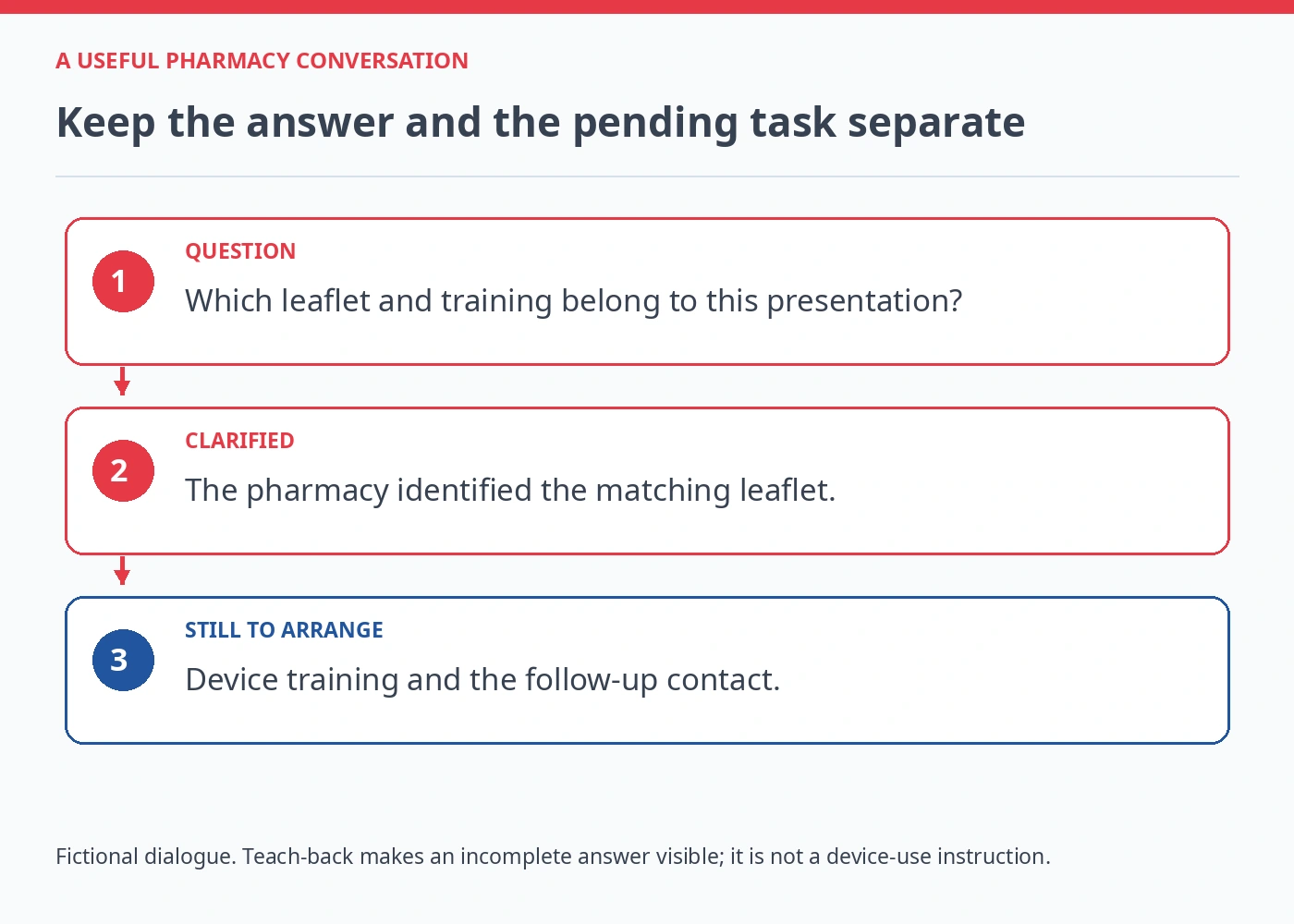
Illustrative patient question: “The supply looks different from last time. Which leaflet and training belong to this presentation?” The pharmacy identifies the matching leaflet but still needs to arrange the training contact.
Patient’s check: “I understand which document to keep. I am still waiting for the device training and the contact details. Who will arrange those, and how will I hear back?” The note records two separate outcomes: document identified; training follow-up pending. It does not turn a partial answer into confirmation that every instruction is understood.
Make other medicines part of the conversation
Bring a current list that includes prescription medicines, nonprescription products and supplements. Include the names and labelled details rather than broad descriptions such as 'a vitamin'. Explain any change since the prescription was discussed. The list supplies context for the professional; it is not a basis for deciding on your own that a combination is safe. [1]
For the clinical questions that sit alongside product instructions, see HGHThai’s questions for the treating team
Before that conversation, identify other medicines and supplements for review, including whether each item is current, stopped or only being considered.
Close the loop before leaving
Write the answer beside each question and mark anything still unresolved. Repeat the instruction in your own words and ask the pharmacist to correct misunderstandings. If further training or contact with the prescriber is needed, note who will arrange it and how you will receive the answer. A written follow-up task is easier to act on than a vague reminder.
If you cannot explain the answer back clearly, use a structured language-clarification note. Reading Medicine Information in a Second Language: A Patient Checklist
Unanswered questions deserve a follow-up task, not a guess
A question card is not device training or a treatment plan. Use the instructions confirmed for your own prescription and ask again when the explanation remains unclear.
Sources and reading context
- HealthHub somatropin patient information — Brand-specific device instructions and questions for the healthcare team; not a universal regimen
- AHRQ preparation for healthcare appointments — Organize concerns, questions and medicines for discussion